
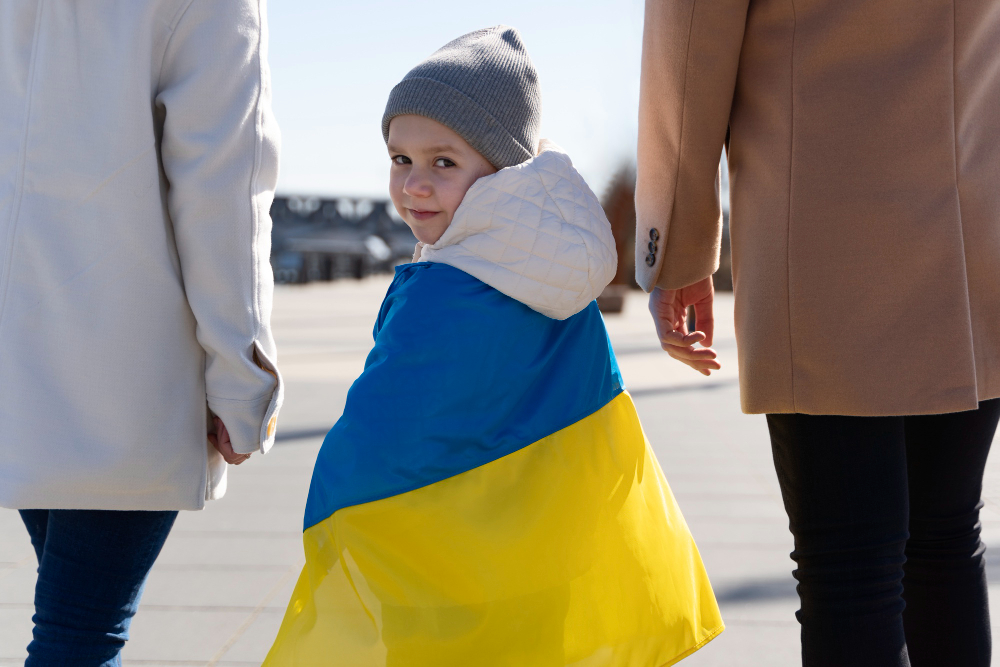
Poland approves plans to end special aid for Ukrainian refugees
Poland’s government has approved draft legislation that would bring an end to the special assistance granted to Ukrainian refugees after Russia’s full-scale invasion in 2022, when millions fled to Poland. Nearly one million Ukrainian refugees are still living in the country.
Announcing the proposal at a press conference on Tuesday, government spokesperson Adam Szłapka said the situation had stabilised after almost four years. “We are no longer facing a large, simultaneous influx of refugees,” he said.
He noted that most Ukrainians in Poland are now employed and that their children are enrolled in school. “This allows us to withdraw extraordinary measures and move from temporary solutions to a more permanent, systemic approach,” Szłapka added.
Poland introduced special support measures for Ukrainian refugees in March 2022, at a time when arrivals were at their peak. Since then, the legislation has been repeatedly extended.
Last year, however, the issue became a point of contention between the government and newly elected President Karol Nawrocki, who is aligned with the right-wing opposition. In August, Nawrocki vetoed a bill that would have prolonged the support under existing conditions, arguing that it unfairly favoured Ukrainians over other groups.
A compromise was eventually reached, extending assistance until March 2026 while making access to some benefits conditional on employment. The president made clear this would be the final extension, saying Poland should return to “normal conditions” and treat Ukrainian citizens the same as other foreigners, according to his chief of staff, Zbigniew Bogucki.
The newly agreed measures, approved by the government on Tuesday but still requiring parliamentary and presidential approval, would take effect in March 2026. Some forms of special support would end immediately, while others would be phased out by March 2027.
In their place, the legislation would establish a single, unified support system for all foreigners under temporary protection in the EU, regardless of nationality. This would include equal access to social benefits, employment and healthcare, according to Prime Minister Donald Tusk’s office.
The interior ministry said healthcare provision would gradually shift to a system similar to that for Polish citizens, based on insurance and contributions. Ukrainians without health insurance would be treated in the same way as uninsured Poles, with exceptions for children, pregnant women, victims of violence and wounded soldiers.
Measures designed to help Ukrainian children integrate into Polish schools—such as Polish-language lessons, preparatory classes and simplified hiring rules for intercultural assistants—will end at the close of the current academic year.
Access to accommodation and food assistance would be limited to particularly vulnerable individuals, including the elderly and people with disabilities. In addition, Ukrainians would lose the special right to set up businesses under the same conditions as Polish citizens, reports Gazeta Wyborcza.
Several human rights organisations have criticised the proposals, warning they could leave vulnerable people without adequate protection and increase the risk of homelessness. The Helsinki Foundation for Human Rights argues that a provision requiring applicants to obtain a Polish identification number within 14 days breaches EU law and may be difficult for some Ukrainians to comply with due to the war.
Similar concerns have been raised by the office of Poland’s Commissioner for Human Rights, according to Gazeta Wyborcza.
The Lewiatan Confederation, which represents large employers, has also criticised the plans, saying they would restrict the simplified hiring of Ukrainian workers. The group warned this could disrupt the labour market, noting that Ukrainians account for around 66% of Poland’s roughly one million foreign workers.
Lewiatan also objected to a provision that would strip temporary protection from foreigners who leave Poland for more than 30 days, pointing out that no exceptions are предусмотрены for employees posted abroad by Polish companies.
The bill may still be amended during parliamentary debates, where the government holds a majority. Once passed, President Nawrocki could sign it into law, veto it, or refer it to the constitutional court.
While the large-scale arrival of Ukrainian refugees in 2022 initially triggered widespread public support, including Poles hosting refugees in their homes, public sentiment has since shifted.
A poll released this month by the state research agency CBOS found that 46% of Poles now oppose accepting Ukrainian refugees—the highest figure recorded to date. Another survey conducted in September by United Surveys for Wirtualna Polska showed that 37% of respondents view Ukrainians in Poland negatively, up from 29.5% two years earlier.